 Posted by
 [By Kyana Givens, FDP Special Counsel for Strategic Litigation and Automation]
The Eleventh Circuit handed the government a gift in US v. Blair, No. 23-13642 (May 1, 2026). Here is what it means, what it does not touch, and where your successful challenges still live.
If you practice in the Northern District of Georgia, you may already know Blair. This case had fingerprints from a lot of talented people. The FDP was assigned midstream after retained counsel withdrew when the government disclosed the co-conspirator was funding the defense. Inherited cases carry inherited records, and rulings from the Honorable Leigh Martin May, Chief Judge, narrowed what could be built at trial further still. Every client (and every trial) carries a story the record does not capture. What follows is only about the record and hopefully a map forward.
The Blair published opinion is the first in this circuit holding that Cellebrite does not require expert testimony for admission. The court called it plug-and-play: a lay agent who ran the extraction can authenticate the output without a forensic expert. Four other circuits agree. The Fifth and Ninth Circuits reached the same result in published opinions. See US v. Williams, 83 F.4th 994 (5th Cir. 2023); and US v. Jimenez-Chaidez, 96 F.4th 1257 (9th Cir. 2024). The Second and Fourth have as well, in unpublished decisions that carry no binding weight even at home. See US v. Marsh, 568 Fed. Appx. 15 (2d Cir. 2014) (unpublished summary order); and US v. Chavez-Lopez, 767 Fed. Appx. 431 (4th Cir. 2019) (unpublished). The government is going to lead with all of this every time a phone hits a discovery packet.
Take a breath. The holding is narrower than it sounds. The court answered one question about one fact pattern: texts, photos, and call records pulled from a functioning phone by an agent who plugged it in and ran the program. That is it. Everything outside that box is still yours to litigate. And there is a lot outside that box.

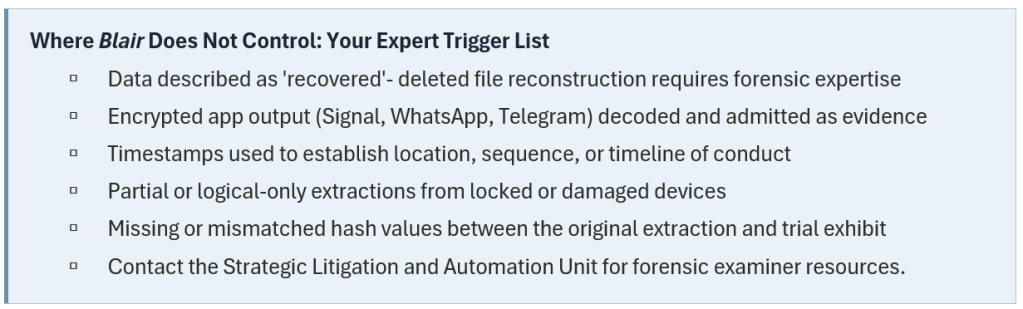
Here is where the sunlight is. If the government says Cellebrite “recovered” something, that word is doing forensic work that a non-expert agent cannot explain; deleted data reconstruction requires knowledge of file systems and carving algorithms a layperson does not have. If the output involves Signal, WhatsApp, or Telegram, those applications store data in encrypted databases that require app-layer decryption to read, and that does come simply through plugging in a phone. If Cellebrite timestamps are anchoring a timeline or placing your client somewhere, timestamp normalization across operating systems and carriers is forensic interpretation, full stop. If the device was locked or damaged and only partially extracted, the agent who ran the tool has no idea what was excluded. And if you cannot get matching hash values from discovery, the government cannot verify that the exhibit it showed the jury matches what was on the device.
None of these are exotic arguments. They are the arguments that Blair did not get to develop at the district court level, for reasons rooted in the conditions of that litigation. The court ruled on the record it had. In your future cases, you get to build something different.
The one move that changes everything is the same in most cases: retain a qualified digital forensics expert during discovery. Not after the government drops its exhibit list. During discovery. Get the full extraction report, not just the exhibits. Ask for the hash values. Let your expert read the report before you brief a single issue. The argument that was dismissed as “hypothetical” in Blair becomes a concrete reliability challenge the moment an expert connects it to the facts and a specific exhibit. That is the difference between admitted or excluded.

One more tool in your kit: the 2023 amendment to Federal Rule of Evidence 702 was adopted to reinforce the court’s gatekeeping obligation and to make clear that the proponent of expert testimony bears the burden of establishing admissibility by a preponderance of the evidence. That amendment does not evaporate because the government labels its witness a lay witness instead of an expert. Where Cellebrite output requires interpretation beyond common knowledge, the gatekeeping obligation is triggered regardless of the label the government put on the person explaining it.